☰



By Russell Goldman, Founder of Buildable Engine
Every builder knows how this goes. You are weeks into a project, sometimes months, when something surfaces that was wrong from the beginning. A corridor that does not meet egress width. A room dimension that violates local code. A door swing that conflicts with an adjacent wall. The design looked fine. The plans looked clean. But somewhere between the drawing and the building department, reality intervened.
What follows is familiar enough to require no elaboration: a call to the architect or drafter, a revised set of plans, a resubmission, a waiting period, and a schedule that has just compressed in ways you will be absorbing for the rest of the project. The fix itself might cost a few thousand dollars. The delay costs considerably more, and that cost does not announce itself as a line item. It shows up in overtime, in rescheduled subcontractors, in client conversations that erode the trust you spent months building, and in the faster, less certain decisions you will be making for everything that comes after.
This is not a rare edge case. It is the rule. The construction industry has built an entire professional language around managing exactly these consequences: RFIs, change orders, contingency budgets, schedule float. These are not tools for exceptional situations. They are the infrastructure of a system that has accepted late-stage error as a normal feature of how work gets done.
The visible cost of a compliance failure is the fix. The invisible cost is everything that the fix displaces.
When plans need to be revised after permitting has started, the redraw is only the beginning. The time your team spent working from plans that are now wrong does not come back. The subcontractors who need to be rescheduled will not hold their slots indefinitely. The client who was expecting a clean process is now watching a messy one, and that changes the nature of the relationship in ways that outlast the project itself. One GC described his version of this as simply as it can be described: once he has a system set up, he should be able to go. Right now, he cannot. The stops and restarts are built into how his work flows, and they cost him time and margin on every project, not occasionally but predictably.
A remodeler with thirteen years of experience put it differently after watching a compliance audit run against one of his plans for the first time. His reaction was not enthusiasm for the technology. It was something quieter, closer to the feeling of tallying up what you have been absorbing without realizing you had any other option. "How did I survive?" he asked.
Construction has a well-understood but consistently ignored principle: the cost of fixing a problem grows by an order of magnitude at every stage of the project lifecycle. A compliance issue caught during early design costs an hour of revision time. The same issue caught at permit submission costs weeks of delay. Caught in the field, it costs change orders, rework, and in some cases structural modifications that ripple through the timeline of everything else on site.
The window before permit submission is the only point in a project where the fix is inexpensive, where the plans are still fluid, the team is still in planning mode, and no physical work has been done that needs to be undone. And yet most builders have no systematic way to take advantage of it. Compliance review happens manually, when it happens at all, and manual review under deadline pressure is precisely where things get missed. "Not everything should be built from the ground up," one GC told us, describing what he actually needed: a way to take a set of existing plans and run them against the relevant code before committing to them, to find out what is wrong while fixing it is still cheap.
Custom home builders and smaller GCs typically operate on project margins somewhere between fifteen and twenty-five percent. A single permit rejection that delays a project by four to six weeks can erase a meaningful portion of that margin, not just through direct costs but through the carrying costs, the opportunity cost of a team that is stalled, and the client relationship damage that makes the next referral a little less certain. Compounded across a full year of projects, the drag is significant even when each individual instance looks manageable.
The $92 billion figure that researchers attribute to pre-permit rework in the US construction industry is not driven by catastrophic failures. It is driven by the accumulation of small problems caught too late, multiplied across hundreds of thousands of projects every year. Together they represent the single largest productivity drain in the industry, and most of it is preventable at the earliest stage of the process, when the cost of prevention is lowest and the leverage is highest.
The builders and GCs who encountered an automated compliance audit for the first time did not respond with skepticism about whether it could work. They responded with recognition that the problem it was solving was one they already knew. "It would help me secure jobs," one builder said, describing how showing a client a clean compliance report before submission changes the sales conversation before it even begins. Another put it the way any builder would want to be described: "It makes you look more professional as a company because you are not making mistakes last minute." A small GC reached for a phrase that builders have used for generations: "It is like measure twice, cut once. Mistakes are significantly reduced."
Compliance automation does not change what you build. It changes when you find out whether you can build it, moving that discovery from the most expensive moment in the project to the cheapest one, and doing it systematically rather than by luck or experience or the particular attention of whoever happens to review the drawings on a given afternoon.
There is another dimension to this that builders rarely discuss directly but universally experience. The homeowner arrives with an idea that has not been validated by anyone. They have sketched something on paper, found a floor plan they loved online, or described a vision to a designer who produced something beautiful and possibly unbuildable. They are now sitting across from you expecting a price and a timeline for something that may not pass code, may not fit the lot, and may need to be substantially redesigned before a permit can be filed.
In conversations with homeowners planning renovations and new builds, the most consistent anxiety was not about cost overruns or contractor quality. It was about showing up to a professional with something wrong, wasting time and money and credibility in the same moment. One homeowner described what she was looking for as "confidence that my ideas are buildable and code-aware before I spend real money." That anxiety, when it goes unaddressed, lands on the builder. The scope creep, the redesigns, the expectation mismatches that define the early weeks of too many projects all trace back to an idea that was never checked before it became a commitment. A builder who can hand clients a simple way to validate their plans before the first meeting changes what that meeting is, arriving with cleaner inputs and a client who already understands the shape of what is actually possible.
The construction industry has invested heavily in tools that help builders manage work once it starts: project management platforms, field coordination software, scheduling systems, cost tracking tools. These are valuable and builders rely on them. But they all operate downstream of the decision that determines how hard the work will be, which is whether the plans were right before construction began.
Buildability Intelligence is the term we use at Buildable Engine for the systematic capacity to evaluate whether a design can actually be built as specified, before anything is permitted or poured. It is not drawing review, which is a task with variable results depending on who does it and when. It is a capability: an automated, rules-based evaluation of every element in a plan against the codes, dimensions, and spatial requirements that govern whether it can be permitted and built in a given jurisdiction. Upload any floor plan and get back a full compliance audit in minutes, with every violation flagged against IBC, ADA, and local code, exact measurements extracted, suggested fixes generated, and a full audit trail. The same spatial data that powers the compliance check also feeds cost estimation inputs, material quantity extraction, and coordination checks, which means one upload does what previously required several separate tools and several separate conversations.
Think of it as the inspection that happens before the work starts rather than after, except that instead of telling you what went wrong, it tells you what will go wrong if you do not fix it now, when the fix is still just a change to a drawing rather than a change to a building
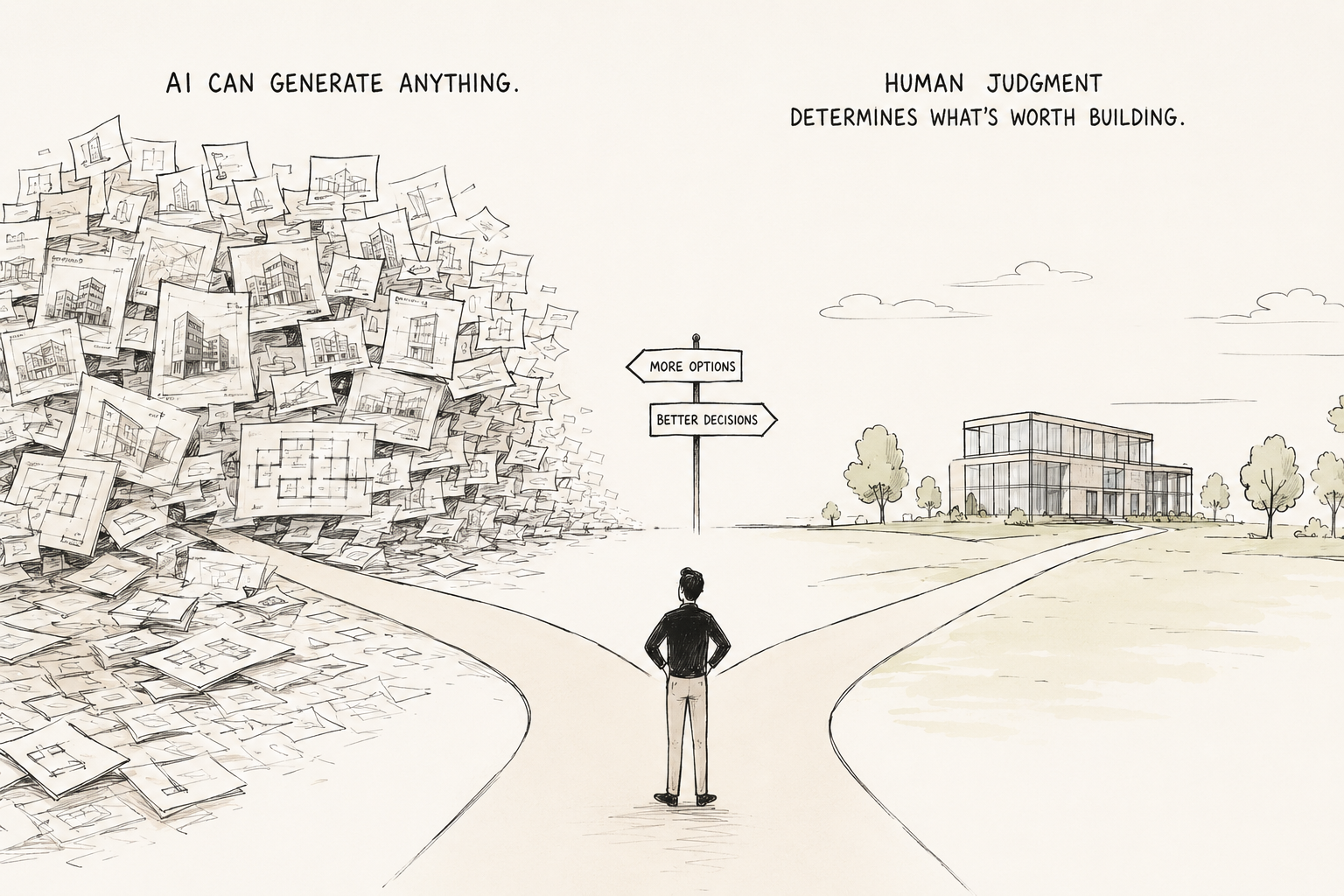
As AI makes it nearly effortless to generate endless possibilities, the harder problem becomes deciding what actually works. The next frontier of AI may be systems that can evaluate, optimize, and navigate complexity—while leaving humans to define what “better” means.