☰



By Russell Goldman, Founder of Buildable Engine
America’s buildings are maintained and delivered by a silent army of electricians, HVAC techs, plumbers, welders, operators, and installers, and that army is retiring faster than it is being replaced. JLL estimates 2.1 million skilled trades jobs could go unfilled by 2030, with as much as $1 trillion in annual economic impact. Most coverage of that figure will frame it as a workforce problem, and the framing is not wrong, but it is incomplete. At the same time that the field is losing bodies, construction is hiring more managers, analysts, coordinators, and technical staff just to navigate growing complexity, and the more important story is what that second trend is actually telling us about where the industry’s productivity crisis lives.
A new analysis from the National Association of Home Builders, drawing on 2024 American Community Survey data, tells the fuller story. The share of construction trades workers has declined from 71% of the workforce in 2005 to less than 59% today. Over that same period, computer, engineering, and science occupations more than doubled their share, and management and business roles expanded by 73%. Management ranks grew from 1.2 million workers to 2 million, from roughly 10% of the workforce to 17%.
This is not the profile of an industry replacing lost tradespeople with other tradespeople. It is the profile of an industry absorbing complexity through headcount.
Every additional layer of code and compliance, every new stakeholder in a financing stack, every disconnected software platform that doesn’t talk to the next one: each of these creates a coordination need that someone has to fill. When software doesn’t integrate, people become the integration layer. When regulation grows denser, you hire someone to interpret it. When lenders require deeper diligence on cost certainty, entitlement exposure, and schedule credibility, you staff up to produce it. The NAHB’s own analysis notes that the expansion of management and business roles may reflect increasing regulatory complexity, permitting requirements, and compliance costs, all of which can lengthen project timelines and raise overhead without directly increasing output, which is a careful way of saying: we’re spending more to produce the same thing.
The labor crisis in construction has two faces, and most coverage only sees one of them. On the field side, there are fewer skilled tradespeople, a workforce aging out faster than apprenticeship pipelines can replace it, and physical tasks that resist easy automation. On the office side, there are too many humans required for code review, permitting coordination, plan QA, lender diligence, procurement alignment, revision management, and documentation, not because those people aren’t good at their jobs, but because the software layer that should be doing much of that work was never built. Both shortages compound each other: field productivity suffers when the upstream information is wrong, and office productivity suffers when every coordination problem has to be resolved by a person rather than a system. America doesn’t just lack enough people to build; it increasingly lacks enough people to coordinate building efficiently, and those are different problems that require different solutions.
If 2.1 million workers are missing, the answer cannot simply be to hire 2.1 million workers. The answer has to include better preconstruction intelligence, automated plan analysis, faster permitting workflows, fewer field errors, robotics where physical labor is hardest, and software that reduces human coordination load across the board, because the alternative is continuing to grow the management apparatus faster than the work itself grows, which is not a productivity model anyone would design on purpose.
There’s a tendency in this industry to treat field inefficiency as the primary productivity problem. If crews were faster, if trades were better coordinated, if prefabrication scaled, the thinking goes, we’d close the gap. Field performance matters, but many inefficiencies that look like field problems are actually upstream failures arriving late: incomplete plans, missed code requirements discovered after framing, design conflicts between disciplines that nobody caught before the permit was filed, materials sequenced wrong because the coordination happened on a spreadsheet. When a crew stands idle waiting for clarification, that’s not a labor productivity issue. It’s an information failure that traveled until it became someone else’s expensive problem.
The field absorbs what the office produces, and right now the office is producing more people to manage more complexity rather than fewer problems to begin with.
This matters well beyond any single project or firm. America is entering an era where it needs to build more, faster, and with higher complexity than at any point in decades: housing, energy, AI data centers, semiconductor manufacturing, healthcare facilities, climate infrastructure, grid modernization, logistics and warehouse capacity. Every one of those sectors is in active expansion at the same moment that the labor model supporting them is weakening on both ends. The housing shortage represents millions of units of unmet demand. Data center construction is doubling to support AI infrastructure, with hyperscalers alone expected to spend roughly $700 billion this year on capital expenditures that will ultimately require physical buildout. Semiconductor plants are being built domestically at a scale not seen in a generation. Healthcare systems are expanding as demographics shift. The grid requires physical buildout at a pace that regulators and utilities are only beginning to absorb. That is not a local problem or a single-sector problem. It is a national productivity constraint, and its price tag runs into the trillions.
The real signal in the NAHB data is that construction has become, whether it intended to or not, an information industry wrapped around a building site. The decisions that determine project outcomes, including feasibility, compliance, scope definition, risk pricing, and procurement, are increasingly being made by white-collar workers before a foundation is poured, and the problem is that those decisions are still being made with the same tools and the same manual review processes that existed when trades workers were 71% of the workforce. More analysts and managers and coordinators are doing the work that software should be doing, and that is not an indictment of those professionals. It is a description of the gap the industry hasn’t filled yet.
In every other high-stakes domain where decisions carry real consequence, the industry eventually built a systematic intelligence layer to support them. Capital isn’t allocated without financial intelligence. Loans aren’t underwritten without credit intelligence. Insurance isn’t priced without actuarial intelligence. Construction is the exception: a domain where projects are approved, financed, permitted, and built without any equivalent layer applied to the physical design itself.
This is where the next major productivity gain will come from, not from asking the field to move faster, but from removing friction before anyone arrives on site.
At Buildable Engine, we think of this as the intelligence layer: software that sits above plans, drawings, and workflows and converts static documents into decisions. Not a drawing review tool, and not a project management platform, but an analytical layer that understands the geometry and spatial relationships within a design and can evaluate it against code requirements, constructibility standards, and internal firm criteria before anything goes to permit. When that layer exists, the compliance reviewer doesn’t need to read every sheet manually, the permit submission doesn’t go in with unresolved conflicts, the lender’s consultant doesn’t spend weeks reconstructing what should have been knowable from the drawings, and the work that currently requires a growing army of coordinators gets done faster, earlier, and with a defensible record of how every determination was made.
It’s worth being clear that the long-term productivity opportunity in construction isn’t only a white-collar problem. Physical automation is coming to the field as well, and it will matter. Startups like Arcadia are building scanning and spatial intelligence technologies that make the physical world more legible to machines, capturing real conditions, tracking progress, and closing the gap between what was designed and what was built. Robotic layout, autonomous equipment, prefabrication at scale: these are real directions, not distant ones, and they will eventually change what it means to build something.
But physical automation and intelligence automation are not substitutes for each other. They are dependencies. A robot still needs to know what to build, where to build it, whether the plan it’s executing against is compliant, and what changed since the last revision. Scanning technology can tell you what exists in the field; it cannot tell you whether the design that produced it was correct to begin with. If the upstream plan has unresolved conflicts, missed code requirements, or coordination failures baked in, physical automation doesn’t eliminate that problem. It executes on it faster. The intelligence layer isn’t a waypoint on the road to physical automation; it’s the foundation that physical automation requires in order to work, which means that for construction to realize productivity gains at both ends, the building data has to be trustworthy before it reaches any machine, human or robotic, that acts on it.
The NAHB data points to a real structural shift in how construction is organized. The question worth asking is whether that shift represents a permanent new cost structure, or a transitional state before the right intelligence layer existed to absorb it. We think it’s the latter. And we’re building for that.
If you’re a builder, developer, architect, or lender thinking about what this next operating model looks like, we’d welcome the conversation.
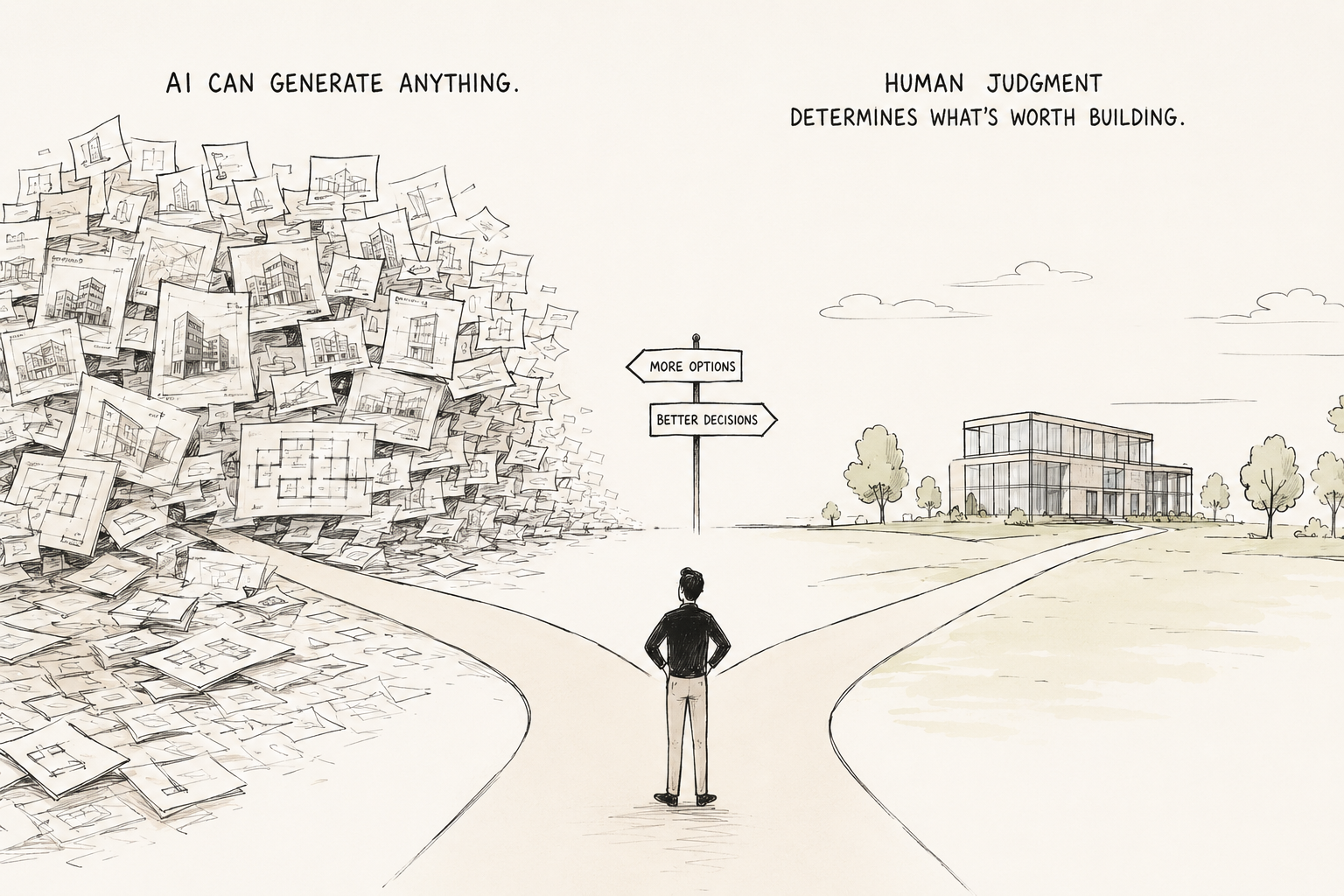
As AI makes it nearly effortless to generate endless possibilities, the harder problem becomes deciding what actually works. The next frontier of AI may be systems that can evaluate, optimize, and navigate complexity—while leaving humans to define what “better” means.