☰


When news broke that a major office-to-residential conversion in Midtown Manhattan had been evacuated after reports of buckled columns and sagging floors, much of the industry's attention immediately turned to a familiar set of questions. What caused the structural instability? Was there an engineering error? A construction error? An inspection failure? A flaw in the design? Those questions are both necessary and appropriate, and the investigation will ultimately determine where responsibility lies. Until then, speculation serves little purpose.
There is, however, another question that deserves just as much attention because it extends far beyond a single project. How does an industry capable of designing some of the world's most sophisticated structures still find itself reacting to conditions only after they have become serious enough to halt construction, evacuate neighboring buildings, and require emergency stabilization? Regardless of what investigators ultimately conclude about this particular incident, it is worth asking whether the systems we rely on to understand buildings have kept pace with the complexity of the buildings themselves.
Over the last several decades, construction projects have become dramatically more ambitious. Office towers are being converted into residential buildings. Existing structures are being expanded vertically, retrofitted for new uses, and integrated with increasingly sophisticated mechanical, electrical, and life safety systems. At the same time, projects are moving faster than ever. Schedules are compressed, teams are larger and more distributed, and decisions made by one discipline often have immediate consequences for many others. Individual buildings have gotten more complex, and so has the information needed to design, build, renovate, and operate them safely.
The industry's response has been to digitize almost everything. Drawings have become BIM models. Filing cabinets have become cloud platforms. Paper markups have become digital workflows. Artificial intelligence is beginning to automate plan review, extract information from construction documents, and summarize project data that previously required hours of manual effort. These advances are meaningful, and they have undoubtedly improved productivity. Yet they all share a common assumption: that if we become better at managing construction information, we will become better at managing construction itself, and I am no longer convinced that assumption is sufficient.
The industry's greatest challenge isn't that information exists in too many places, though it often does, or that our documents are hard to search, or that our workflows remain unnecessarily manual. Those are symptoms. The deeper problem is this: buildings are physical systems whose condition changes continuously throughout design, construction, renovation, and operation, while the systems we use to track them remain organized around static snapshots — drawings, specifications, reports, inspection records, photographs — that each capture one isolated moment in time. We have gotten very good at organizing information about buildings without meaningfully improving our ability to understand the buildings themselves as living, changing systems.
That distinction sounds subtle, but it has real consequences. A building under construction is not the same building that existed when its permit drawings were submitted. It changes every day. Temporary supports go up and come down. Structural members get reinforced or modified. Openings are cut. Sequencing shifts. Field conditions turn out to differ from assumptions made months earlier. Approved revisions accumulate. Each of these changes affects the building's current state, yet much of the technology supporting the industry still evaluates static snapshots rather than an evolving reality.
Whatever the New York investigation ultimately finds — engineering decisions, construction sequencing, unforeseen field conditions, or some combination — it's a reminder of something easy to lose sight of. Buildings don't become complex only when something goes wrong. They're complex every day. We just don't usually notice, because most days nothing forces us to look. The real question for our industry is whether the next generation of construction technology should keep helping us manage documents more efficiently, or start helping us understand the buildings those documents are trying to describe.
The construction industry has never had more information than it does today. Every project generates thousands of drawings, specifications, RFIs, submittals, inspection reports, change orders, schedules, photographs, laser scans, BIM models, emails, and calculations. We've gotten remarkably good at creating, storing, and sharing project information, and the software ecosystem reflects that: entire categories of technology now exist to organize documents, coordinate teams, automate workflows, and increasingly, extract information using artificial intelligence.
Those advances matter. But they've also reinforced an assumption worth challenging: that if everyone has access to the right information, better decisions will naturally follow. In practice, that's rarely how construction works. Information doesn't make decisions. People do.
Every significant decision on a project is ultimately a product of human reasoning. Architects reason about design intent, structural engineers about load paths, contractors about sequencing and constructability, owners about cost and risk, plan examiners about code compliance, inspectors about field conditions. The information they draw on may be shared. The reasoning stays distributed — across dozens of individuals, organizations, and moments in time.
For generations this model has worked, because projects relied on experienced professionals coordinating through meetings, drawings, calculations, and established process. Human judgment remains, and should remain, at the center of construction — and it's worth saying plainly that this system has produced safe buildings for a very long time, often under real constraints: compressed schedules, incomplete legacy documentation, judgment calls made with partial information. But the projects themselves have changed. Adaptive reuse, mixed-use development, increasingly sophisticated building systems, faster delivery schedules, and constant design revisions have created a level of interconnected complexity that's becoming genuinely difficult for any individual, or even a single organization, to keep synthesizing on an ongoing basis.
This shows up most clearly during construction, when the building is changing continuously. A permit review evaluates a proposed design at a specific point in time. An engineering review evaluates the information available when it's performed. An inspection evaluates conditions as they exist that day. None of this is flawed — each was designed for exactly the purpose it serves. The problem is that the building keeps evolving in the gaps between those moments. Temporary conditions appear and disappear. Sequencing changes. Field conditions force modifications. Revisions pile up. The building that exists today is not necessarily the building that existed at the last major review.
We've largely accepted this as an unavoidable cost of doing construction, and we compensate through experience, communication, coordination meetings, and additional review. Those practices are essential. But they also point to something worth naming: we've built an extraordinary system for enabling people to reason about buildings, and invested comparatively little in technology that can reason alongside them.
That's not a small distinction, because reasoning is fundamentally different from retrieving information. A document platform can tell you where a drawing is stored. A plan review tool can flag potential code issues in a submitted set. A BIM model can represent geometry with real precision. Each of these solves a real problem. None of them continuously asks: What has changed? How does that ripple through the rest of the building? Which assumptions no longer hold? Which relationships deserve a second look?
Those aren't questions about documents. They're questions about the building itself — and if buildings are becoming more complex, interconnected, and dynamic over time, the technology supporting them needs to evolve too. It can't just help us organize more information or review more drawings. It needs to help us reason about a physical system whose state changes every day. That calls for a different kind of software: one that starts not with the document, but with the building.
Over the past two decades, the industry has invested heavily in digitization — software to manage projects, coordinate teams, author BIM models, review drawings, organize documentation, capture reality through laser scanning, automate workflows, and now extract information using AI. These platforms have transformed how projects get delivered and have become indispensable. But nearly all of them share a common objective: helping people create, organize, distribute, or retrieve information. Reasoning is a different capability. It's not finding a drawing — it's determining whether a change to that drawing alters assumptions made elsewhere on the project. It's not identifying that a structural member was modified — it's understanding how that modification affects adjacent systems, sequencing, downstream calculations, and ultimately the building's behavior. It's not noting that an inspection flagged a concern — it's determining whether that concern, weighed against everything else known about the project, warrants additional analysis before work proceeds.
Construction professionals do this kind of reasoning every day; it's what experienced engineers, architects, contractors, inspectors, and owners are trained for. The question isn't whether technology should replace that expertise — it shouldn't. The question is whether technology can help preserve, extend, and continuously apply that reasoning as the building evolves between the reviews, meetings, inspections, and revisions that punctuate a project.
This is especially relevant to a project like the New York conversion. Whatever investigators conclude, the building almost certainly didn't move instantaneously from stable to requiring emergency stabilization. It got there through a sequence of physical changes, engineering decisions, construction activity, and shifting site conditions. Each of those events added new information — but more importantly, each may have changed the relationships between building components. Understanding how those relationships shift over time is a reasoning problem, not an information management problem, and I call this next category of technology Spatial Intelligence.
It starts from a simple observation: buildings aren't collections of documents. They're interconnected physical systems. Every wall, column, beam, slab, shaft, stair, duct, and opening sits inside a network of spatial relationships, and changing one element can send consequences well beyond the immediate area. A column influences the beams it supports. A structural change may alter mechanical routing. An expanded shaft may affect egress. A revised sequence may temporarily change how loads move through the building. None of these relationships live inside any single drawing or report — they emerge from the building itself.
Understanding them takes more than geometry. It takes software capable of maintaining a computational model of the building as an integrated system, and tracking how that system changes over time. Rather than simply presenting information, Spatial Intelligence reasons across the building's geometry, topology, engineering rules, history, and current state to surface conditions that deserve human attention. What changed? Which assumptions should be revisited? Which downstream systems might be affected? What scenarios should be run before construction proceeds? Which relationships have become more critical because of a recent modification?
Reasoning isn't decision-making, and it's worth being precise about that line. Engineers should keep making engineering decisions. Contractors should keep making construction decisions. Regulators should keep exercising judgment during permitting and inspection. Spatial Intelligence doesn't take over any of that. It expands each stakeholder's ability to understand an increasingly complex building by continuously evaluating relationships that would otherwise stay fragmented across disciplines, documents, and time.
Seen this way, Spatial Intelligence isn't another application competing with existing software — it's a layer that sits above it, turning information into ongoing understanding. Existing platforms remain essential; they generate, manage, and organize the information required to build. Spatial Intelligence uses that information to reason about the building itself. As projects keep getting more complex, I think that distinction becomes one of the defining features of the next generation of construction technology.
If human reasoning stays central to how projects get delivered, what would a spatially intelligent system actually do differently — without trying to replace the engineers, architects, contractors, inspectors, and regulators responsible for the decisions? Not become the engineer, but become capable of continuously reasoning about the building in the gaps between the moments when engineers, inspectors, and regulators are able to review it. Human expertise stays the decision-maker, and technology becomes the persistent analytical layer that keeps important changes and relationships from staying hidden simply because they're scattered across hundreds of documents and months of project history.
Continuous awareness of current state. Every major project is in constant transition — temporary supports go up and come down, members get reinforced, openings get cut, sequencing shifts, revisions accumulate — yet much of today's software still evaluates snapshots rather than maintaining an updated picture of the building itself. One of the most important questions investigators will likely ask about the New York conversion isn't just what failed, but what the building actually looked like immediately before conditions developed. A spatially intelligent system is built around that question: instead of treating the building as a static design, it continuously folds in verified changes so every subsequent evaluation starts from the best available picture of current conditions.
Reasoning about relationships, not just recording objects. Existing software can identify a beam, a column, an opening, and tell you whether it complies with a given requirement. The harder question is what happens when one of those elements changes. Does it alter structural assumptions elsewhere? Affect temporary load paths during construction? Introduce new considerations for adjacent systems or future work? Buildings are networks of physical dependencies, not independent parts, and understanding those dependencies is what engineers spend careers learning to do. Spatial Intelligence doesn't replace that — it gives it a computational framework that can keep evaluating those relationships as the building changes.
Persistent memory. Every project accumulates knowledge — engineering decisions made for specific reasons, field modifications, reinforcements added and later removed, temporary conditions documented and then dismantled. Some of it lives in drawings or reports. A lot of it lives in emails, meeting discussions, calculations, or the memory of people who worked earlier phases of the project. As teams turn over and years pass, that institutional knowledge erodes. A living digital twin should hold onto not just what the building is today, but how it got there — every verified modification, inspection, repair, assumption, and revision — so future decisions draw on the building's actual history rather than a reconstruction pieced together from fragments.
Continuous rather than episodic evaluation. Construction runs on periodic review — permitting, engineering calculations at defined stages, inspections at milestones, coordination meetings. These should stay exactly what they are. The problem is that the building keeps changing between them, and conditions today may differ meaningfully from what was evaluated last week. A spatially intelligent system doesn't wait for the next scheduled check-in to notice that; it continuously flags when a meaningful change may have altered the assumptions behind a prior conclusion, so a human can decide whether renewed review is warranted. It doesn't conclude anything is unsafe. It flags that the premise deserves a second look.
Scenario evaluation. Before a contractor changes sequencing, before an engineer signs off on a structural revision, before an owner considers adding floors or changing occupancy, the team should be able to evaluate the downstream implications. Which systems are affected? Which assumptions need reconsidering? What temporary conditions will construction introduce? These questions rarely have a single-drawing answer, because they depend on understanding the building as one interconnected system rather than a set of separate disciplines. A spatially intelligent digital twin turns that kind of evaluation from manual coordination into something computational — supporting professional judgment rather than replacing it.
Together, these capabilities mark a real shift in what technology does for the industry. For decades, construction software has helped us create, organize, exchange, and retrieve information — and that work remains essential. The next generation should help us reason about the buildings that information describes. It's a subtle distinction, but it changes software's role from passive repository to active analytical partner.
It's worth being clear about what this vision doesn't claim. A spatially intelligent system wouldn't have independently determined the cause of what happened in New York, and no responsible technology can claim it would have prevented the incident outright. Structural failures are complex, shaped by engineering decisions, construction execution, material behavior, unforeseen conditions, and more — all of which require rigorous professional investigation to sort out. What a system like this can do is continuously integrate evolving project information, track changing spatial relationships, flag where assumptions deserve a second look, and give engineers, contractors, owners, and regulators a richer picture of the building's current state before conditions escalate into emergencies.
That's the opportunity in front of the industry. Not to eliminate uncertainty from construction — that's not realistic — but to reduce the uncertainty that exists simply because no individual or organization can continuously track every meaningful change happening inside an increasingly complex building. As projects get more ambitious, that kind of persistent computational reasoning may turn out to be one of the more consequential technology shifts the built environment has seen in decades.
If the future depends on a continuously updated understanding of buildings, isn't that just another way of describing a digital twin? The term is everywhere. Owners want them. Cities are investing in them. Vendors describe their platforms as them. At first glance, it can look like the problem is already solved. I don't think it is.
Most digital twins today are genuinely good at representing buildings — consolidating drawings, BIM models, reality capture, sensor data, and asset records into one environment where people can visualize and explore a facility. That's a real achievement, and for owners and operators, a single source of information is a meaningful upgrade over the fragmented systems construction has traditionally run on. But representation isn't reasoning.
Knowing where a structural member sits is different from understanding how modifying it changes the building's behavior. Displaying sensor data is different from evaluating how that data affects engineering assumptions made months or years earlier. Storing inspection history is different from determining whether that history, read alongside recent renovations and current construction activity, suggests additional engineering review is warranted now.
A digital twin, in its basic form, answers "what is the building?" Spatial Intelligence asks the next question: "what does the building's current state mean?" Those are different capabilities, and the gap between them matters more as buildings age and change. A newly completed tower, a hospital mid-renovation, a high-rise adding mechanical upgrades, and an office-to-residential conversion are all in different states of evolution. Their geometry may be well documented, but the engineering implications keep shifting as modifications accumulate over years or decades. A useful digital twin needs to be more than a visual model — it needs to be a continuously evolving computational one, capable of evaluating how those changes affect the building as a whole.
This is where reasoning becomes the defining capability. A spatially intelligent digital twin doesn't just maintain geometry or sync project data — it continuously evaluates relationships across the building: adjacency, connectivity, dependencies, engineering rules, sequencing history, operational changes, proposed scenarios. New information doesn't just get stored. It updates the system's understanding of the building itself.
That shift changes the role of the digital twin substantially. Instead of functioning as a repository or a visualization tool, it becomes an analytical partner throughout the asset's lifecycle — engineers, contractors, owners, regulators, and facility managers all drawing on it. The value stops being just "seeing the building more clearly" and becomes "continuously understanding what its evolving condition means for the next decision."
I don't think Spatial Intelligence competes with digital twins. I think it's the capability that lets digital twins finally deliver on what they've always promised. The twin provides the persistent representation; Spatial Intelligence provides the reasoning that turns that representation into understanding. One without the other is incomplete — a twin without reasoning stays largely descriptive, and reasoning without a continuously updated model has no context to reason against. Together, they're the foundation for much richer engineering analysis, operational decision-making, scenario planning, and risk management than either can support alone.
The future of digital twins, in other words, isn't just richer visualization or more sensors or more data. It's systems that can reason about buildings as they change — and that shift, more than any single feature, is what has the potential to reshape how the built environment is designed, built, operated, and understood.
The official investigation in New York will eventually answer the questions that matter most: what happened, why, and what can be learned from it. Those findings will matter, and the industry should resist drawing technical conclusions before the facts are in. There's a different set of questions, though, that we don't need to wait to start asking.
Did the building's actual condition drift from the assumptions behind earlier engineering reviews? Had the accumulated effect of design revisions, sequencing changes, temporary conditions, and field modifications changed the building in ways no single stakeholder could keep up with? Were relationships between systems going unnoticed — not because the information didn't exist, but because nothing was set up to reason across it continuously?
These aren't questions about who was responsible. They're questions about whether the information architecture behind modern construction has kept pace with how complex modern buildings have become.
If the answer is no, the opportunity isn't just to improve permitting, inspection, or coordination as isolated processes — it's to give every participant better tools for understanding a building that keeps changing. A permit review should stay exactly what it's meant to be: an expert evaluation at a defined point in time. Engineering reviews should stay engineering reviews. Inspections should stay inspections. None of that needs replacing. It needs strengthening by systems that continuously track what's changed in between.
This matters because construction has reached a point where complexity is starting to outpace our traditional ways of coordinating. Office towers become residential buildings. Warehouses become data centers. Hospitals expand while staying operational. Airports go through years of phased renovation. Every one of these is a building whose state keeps evolving, often long after the original permit was approved and the initial engineering assumptions were locked in.
The challenge isn't just designing the building correctly anymore. It's maintaining an accurate, current understanding of it across its entire life.
That's why I think Spatial Intelligence is more than another category of construction software — it's a shift in how we think about the relationship between technology and the built environment. For decades, software has helped us produce drawings, organize projects, coordinate teams, and manage information. That work has genuinely improved the industry, but it's largely been about documenting what we already know. The next generation of technology should help us understand what that knowledge means as buildings keep changing.
None of this is a vision of autonomous construction or automated engineering — quite the opposite. The more complex our buildings get, the more valuable human expertise becomes. Engineers will keep making engineering decisions. Architects will keep balancing competing design goals. Contractors will keep solving problems no algorithm could anticipate. Regulators will keep exercising judgment in protecting public safety. Technology's role isn't to replace any of that. It's to make sure every one of those professionals is working from the most complete, current, and well-reasoned understanding of the building available.
Every era of construction has been defined by a new capability: building taller, safer, more sustainable, more efficient. This next one is different. It's not primarily about how we build. It's about how well we understand what we're building as it changes.
Construction has spent decades digitizing information. The next decade will be defined by whether we can turn that information into continuous reasoning — because buildings don't fail overnight.
Long before steel buckles, concrete cracks, or emergency crews get called to a job site, assumptions shift and risk quietly accumulates. Our job as an industry isn't just to document those changes. It's to understand them, and I don't think we can afford to keep putting that off.
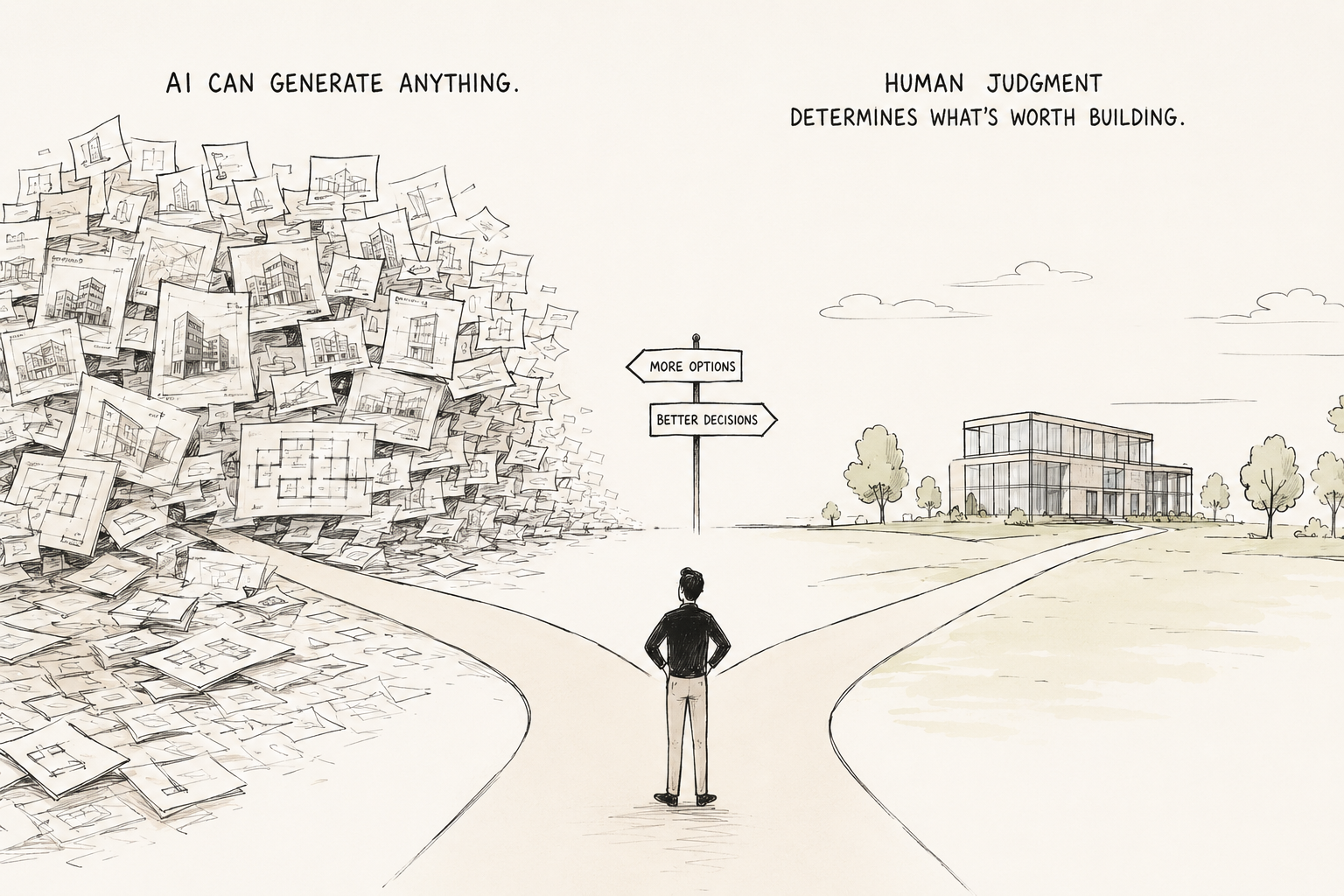
As AI makes it nearly effortless to generate endless possibilities, the harder problem becomes deciding what actually works. The next frontier of AI may be systems that can evaluate, optimize, and navigate complexity—while leaving humans to define what “better” means.

Buildings accumulate disconnected representations of themselves from the moment design begins — drawings, models, specifications, and field records that were never designed to stay in sync — and most of the built environment is operated, maintained, and traded against information that stopped matching physical reality the day construction began. The industry has built an entire economy of workflows to manage that drift, and the next significant shift in construction software is treating it as an infrastructure problem rather than a documentation one.