☰


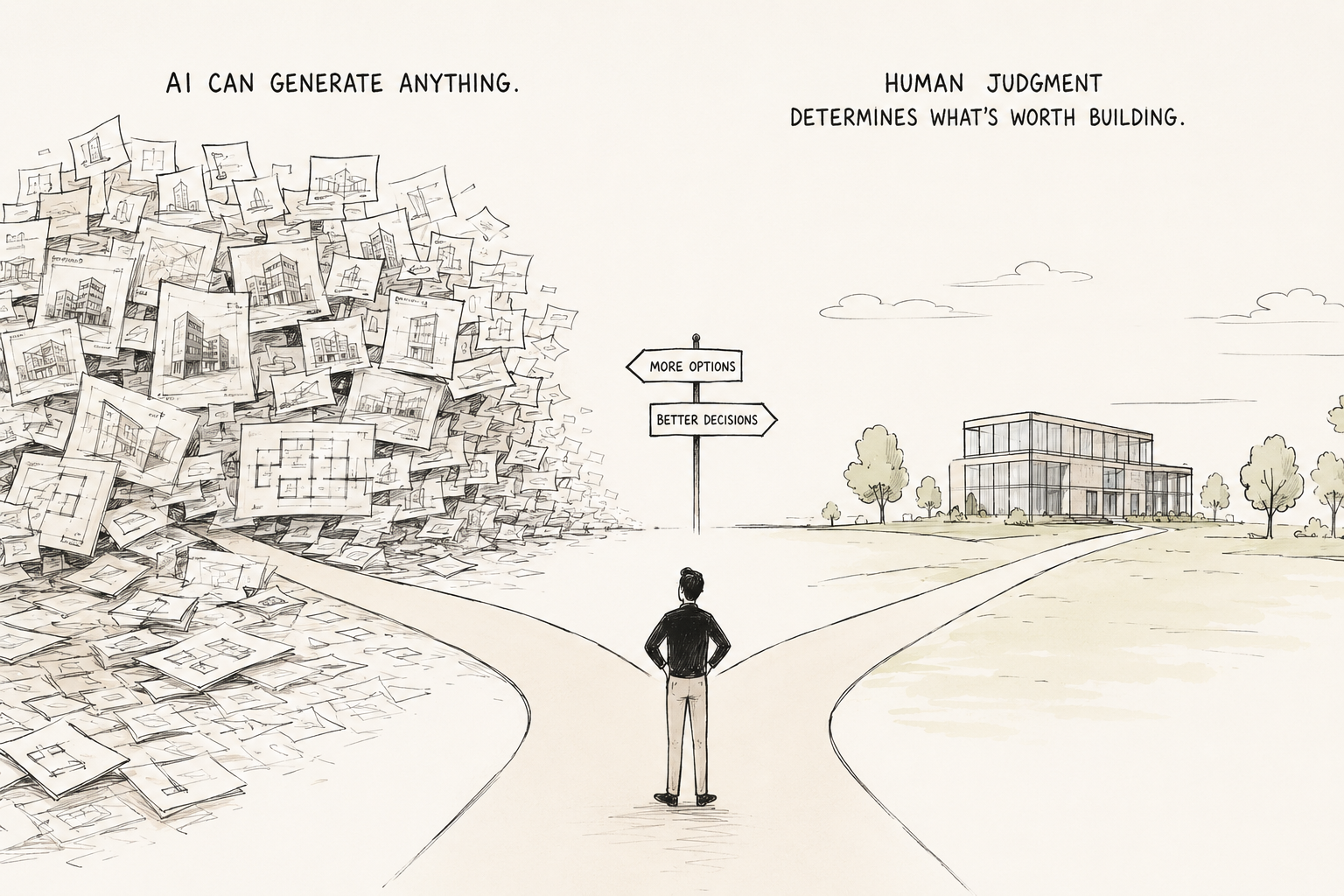
Over the last few years, most of the conversation about generative AI has focused on how much more we can create. We can generate images, software, marketing campaigns, product concepts, building designs, and increasingly sophisticated analyses in a fraction of the time it would have taken a person to produce them. As the models improve, the number of possible outputs we can explore grows as well. Instead of developing three ideas, we can develop 30 or 300, often with almost no additional effort.
This is obviously valuable, but I think it also changes the nature of the problem we need AI to solve. If generating another possibility becomes nearly free, then creating possibilities is no longer necessarily the bottleneck. Evaluating them is.
At first glance, it might seem like AI is already doing both. There are now thousands of software products that use AI not only to create things, but to review them: reviewing contracts for legal risks, code for vulnerabilities, medical records for potential diagnoses, or architectural plans for errors and code violations. The distinction is important, however, because what looks like real evaluation can still be generation. When we ask a large language model to review something, it is generally generating an assessment based on patterns it has learned and the information we have given it. Instead of generating a possible design or answer, it may be generating a list of possible problems, conclusions, or recommendations.
That doesn't make probabilistic review any less useful. In many cases, generating a strong candidate assessment can dramatically accelerate work that previously required significant human time. But producing an assessment and determining whether that assessment is actually correct are two different things. As AI makes it cheaper to generate not only possible solutions but also possible interpretations of those solutions, the harder problem increasingly moves downstream: determining what is true, what actually works, and which possibilities are worth pursuing.
For relatively simple or subjective problems, people can perform that evaluation fairly easily. If AI gives a marketer 20 possible headlines, someone can read them and decide which one is best. If it creates five versions of an image, a designer can look at them and choose one. Even an imperfect output can be useful because the cost of determining whether it is good is relatively low.
That becomes much harder when AI is applied to complex systems, particularly when there are hundreds or thousands of variables that determine whether an answer actually works.
I spend a lot of time thinking about this problem in the built world because it makes the limitation particularly easy to see. Imagine that AI could generate 1,000 different configurations for a new multifamily development. Being able to explore that many possibilities would be extraordinary, especially in an industry where developing even a handful of meaningful alternatives can require significant time from architects, engineers, developers, and consultants.
But someone still has to determine which of those 1,000 possibilities should actually be built.
That isn't simply a matter of choosing the plan that looks best or has the most units. Each option may need to be evaluated against zoning, building codes, accessibility requirements, structural and mechanical constraints, construction cost, schedule, unit mix, rentable area, operating requirements, energy performance, financial returns, and the goals of the people who will ultimately own or use the building. Some of those requirements are absolute, while others represent objectives that can be optimized or traded against one another.
More importantly, those variables aren't independent. As their number grows, the problem begins to look less like a checklist and more like a network, with individual decisions connected to—and potentially affecting—many others. Increasing rentable area may improve the economics of a project, for example, but the design change that creates it might affect circulation, structure, MEP systems, construction quantities, cost, or the experience of the people who will eventually live there. Changes to any of those things can in turn affect still others.
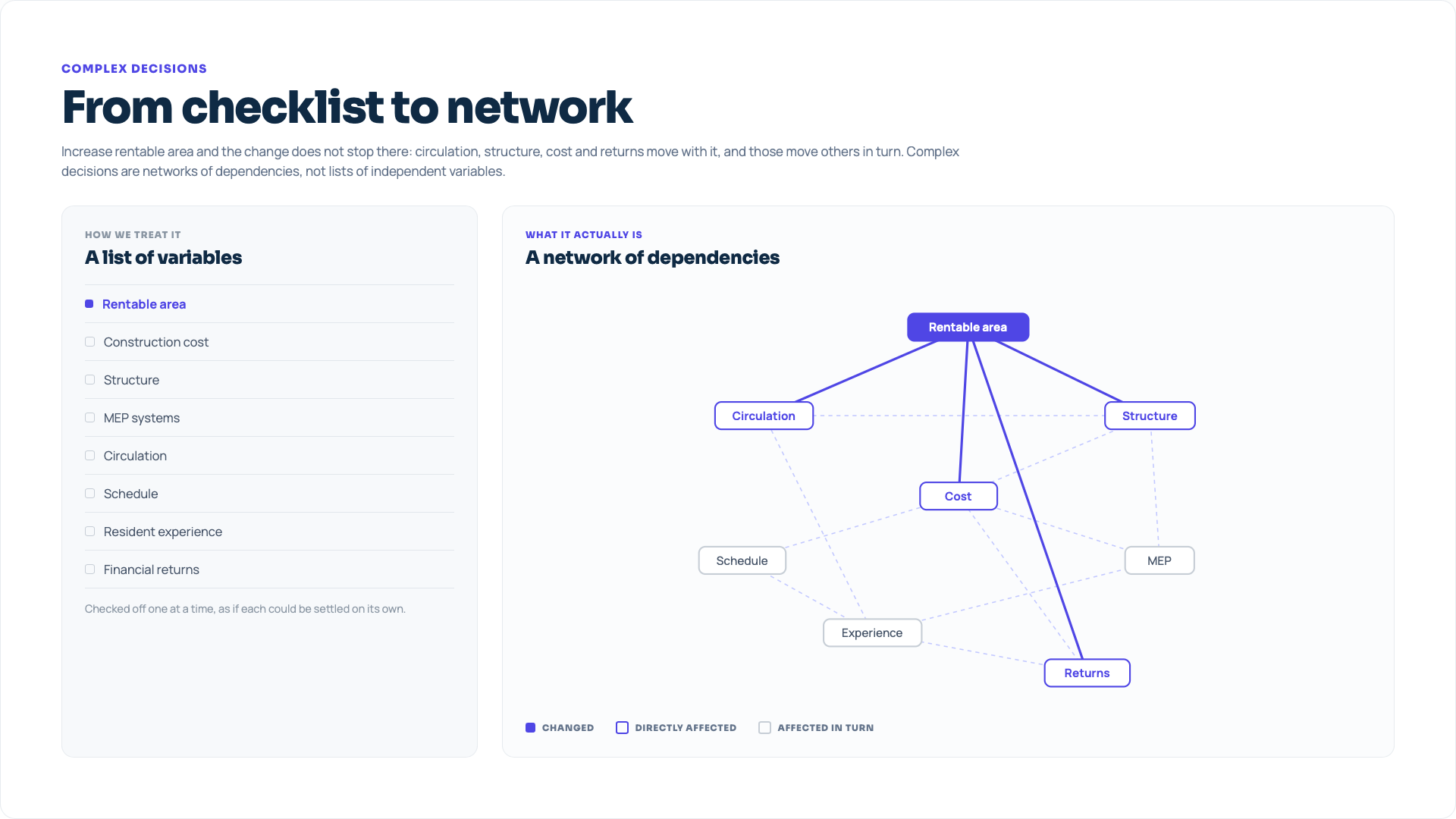
Now multiply that network by 1,000 generated alternatives. The ability to create that many possibilities may be extraordinary, but it creates an interesting problem: it can become easier for the machine to generate the alternatives than for the project team to understand and compare them.
The same problem exists on the review side. An AI system might identify 100 potential issues in a project, seemingly saving an enormous amount of time compared with finding them manually. But the team still needs to know which findings are real, which are important, how they relate to one another, and what happens to the rest of the project when one is addressed. We have accelerated the production of possible findings without necessarily solving the problem of determining what is actually true or what should happen next.
I don't think the answer is to generate less. The ability to explore far more of the possibility space is one of the most exciting things AI gives us. The opportunity is to build the intelligence required to navigate that space.
That requires moving beyond systems that primarily produce answers toward systems that can evaluate those answers against the reality in which they have to operate. In the built world, that means understanding a building not simply as a collection of drawings or documents, but as a system of geometry, spaces, components, requirements, relationships, and constraints. Once those things can be represented computationally, software can begin to determine whether a proposed solution is actually possible, understand what changes when one variable moves, and compare alternatives against the objectives of the project.
Doing that reliably may require different kinds of computation working together. Probabilistic models are extraordinarily useful for interpreting messy information, understanding intent, recognizing patterns, and generating possibilities. Deterministic computation is better suited to questions where an answer can actually be calculated or verified. Models of dependencies can help establish how changes propagate through a system.
Together, those capabilities make something more interesting possible. Instead of asking a machine simply to give us an answer, we can ask it to help us understand the possible answers: which ones cannot work, which satisfy the requirements we've established, what the tradeoffs are among the ones that remain, and what happens elsewhere in the system if we choose one path over another.
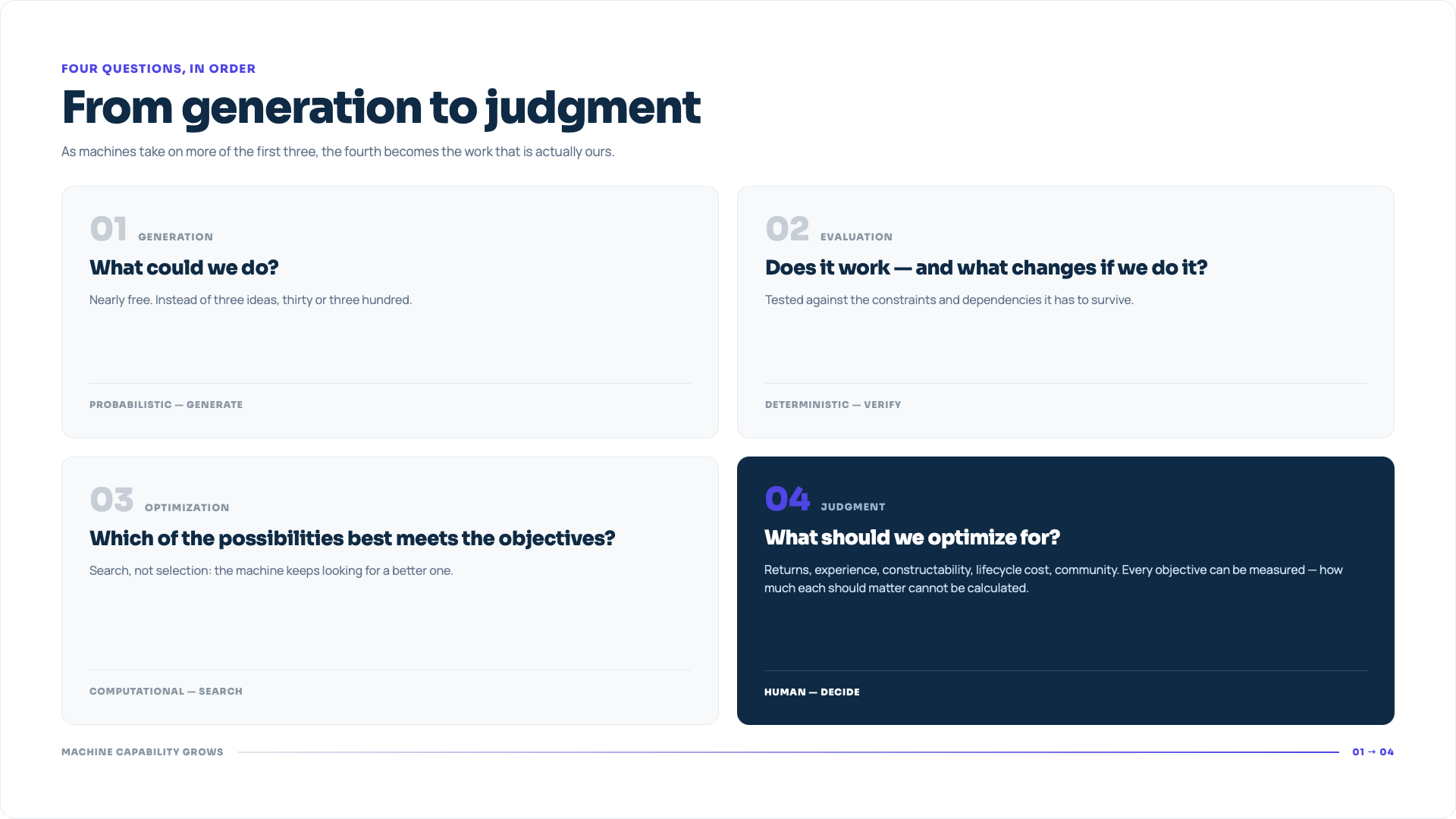
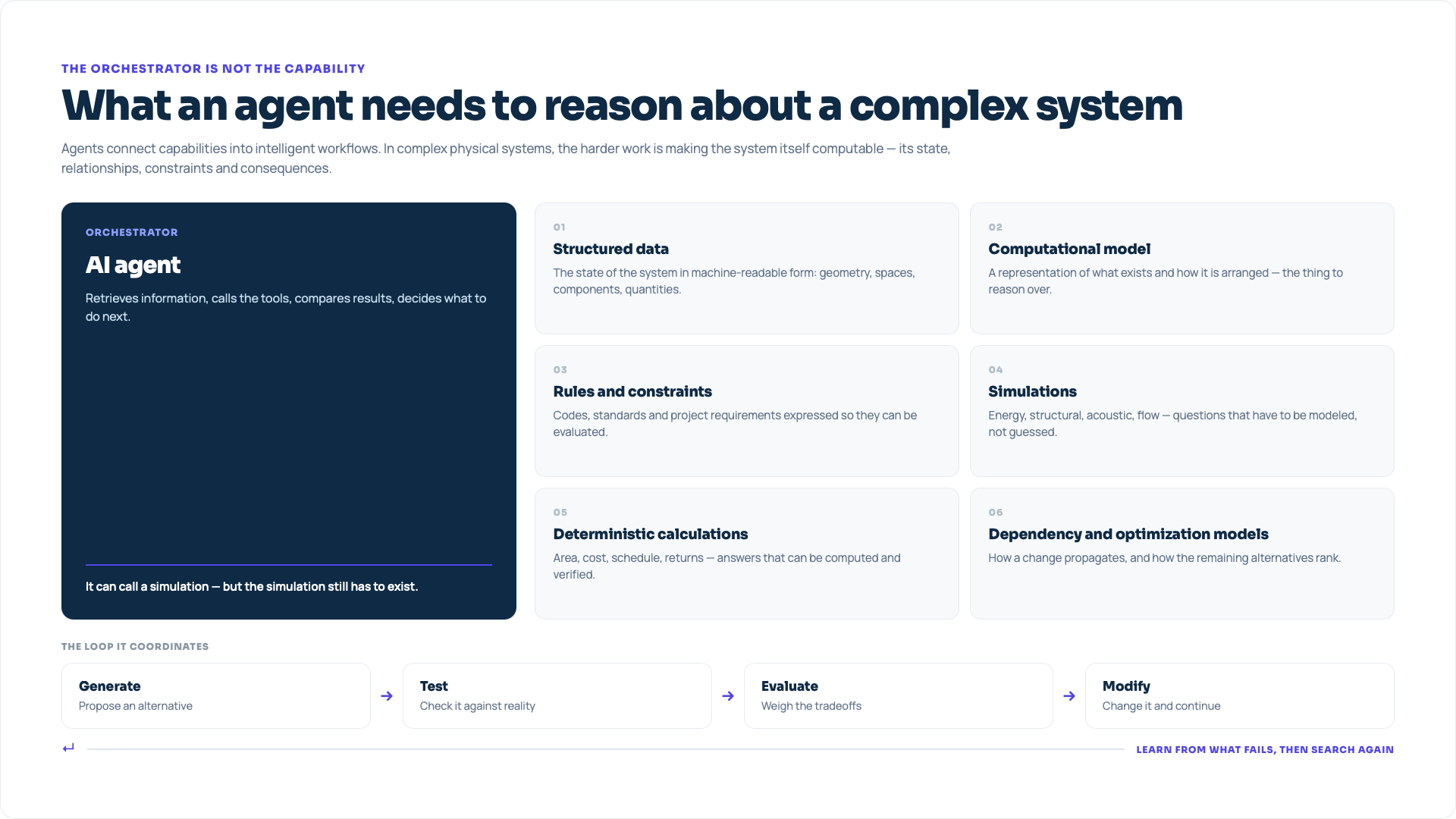
Once a system can both generate possibilities and evaluate them, those capabilities don't necessarily have to remain separate. A system can begin searching the possibility space itself: generating an alternative, testing it against constraints and objectives, learning from what doesn't work, modifying it, and continuing the process.
That changes what optimization can mean. Instead of asking people to conceive every option worth considering and then using software to compare them, the machine can potentially explore alternatives that no person ever explicitly proposed. The value of generation then isn't simply producing more options for people to review. It becomes part of an iterative search for better ones.
Consider what becomes possible as systems get better at doing this. A machine that can generate possibilities, evaluate them against reality, understand dependencies between variables, and continue searching for better alternatives can begin exploring spaces that are simply too large or complicated for people to navigate on their own.
We are already seeing early versions of this in science. In materials discovery, AI systems have explored enormous numbers of potential structures, predicted which are likely to have useful properties, tested those predictions using established computational methods, and used the results to guide subsequent discovery. Similar approaches are emerging in drug discovery, where AI can help generate and refine candidates against multiple biological and chemical constraints. The important shift is that AI isn't simply producing an answer. It is becoming part of a process for searching a possibility space.
The same idea could apply to many complex systems. A manufacturer could search combinations of materials, product designs and production methods. An energy system could evaluate different combinations of generation, storage and demand as conditions change. A supply chain could explore how changes to suppliers, inventory, transportation or production capacity propagate through the network and identify more resilient alternatives. In the built world, a system could search across designs, eliminate those that violate requirements, understand the consequences of different choices, and identify alternatives that perform better against the objectives of a project.
It is tempting to think that companies can simply deploy AI agents to do this today. In some cases, they increasingly can. If the information required to make a decision is already structured and accessible, the tools needed to evaluate different choices already exist, and the information is all contained and neatly packaged up, an agent can retrieve information, call those tools, compare results and decide what to do next.
But an agent doesn't eliminate the need for a model of the problem it is trying to solve. It can call a simulation, but the simulation still has to exist. It can evaluate an option against a constraint, but the constraint has to be represented in a form the system can reliably evaluate. It can reason about what happens when one variable changes, but it needs some way of knowing the dependencies that connect that variable to everything else.
This creates an important distinction between problems companies may increasingly be able to address by deploying agents and those that require new infrastructure. When the data, rules, calculations and tools already exist in machine-readable form, agents can increasingly connect them into more intelligent workflows. But in many complex physical and scientific problems, the harder work is making the system itself computable: representing its state, relationships, constraints and consequences accurately enough that AI has something reliable to reason over.
If we can build that foundation, the opportunity becomes much larger than helping people produce work faster. Machines could help us explore new materials, medicines, manufacturing processes, energy systems, buildings, and other possibilities we could never reasonably investigate one at a time. Their advantage wouldn't simply be that they can produce an answer quickly. It would be that they can search across enormous numbers of possible answers, eliminate the ones that don't work, understand the tradeoffs among the ones that remain, and surface possibilities we might never have thought to consider.
But even a system capable of doing all of that still has to know what we mean by "better."
In a building, there is rarely one objectively correct answer to that question. A developer may want to increase returns. An architect may want to improve the experience of the space. A contractor may care about constructability and schedule. An operator may care about lifecycle costs. A city or community may have an entirely different set of priorities. Many of those objectives can be measured, but deciding how much each one should matter relative to the others is not simply a computational question.
This is why I don't think more capable AI necessarily makes human judgment less important. It may do the opposite. If machines can explore vastly more possibilities than we ever could ourselves, calculate their consequences, eliminate the ones that don't work, and show us the tradeoffs among the ones that do, then humans can spend more of their time on the part of the problem that actually requires judgment: deciding what we are trying to accomplish and which tradeoffs we are willing to make to get there.
For the first phase of generative AI, expanding the number of possibilities was itself the breakthrough. I think the next phase will increasingly be about what happens after those possibilities exist: establishing what is true, understanding what is possible, reasoning through dependencies and tradeoffs, and helping people determine which paths are actually worth pursuing.
If machines become increasingly capable of navigating the possibility space for us, the role of human intelligence doesn't disappear. It shifts. The more effectively machines can tell us what we could do, what will work, and what the consequences of different choices are, the more important it becomes for us to decide what we are actually trying to achieve.
The most valuable AI systems may therefore not be the ones that generate the most. They may be the ones that help us understand what, out of everything we could do, we should actually do.

Buildings accumulate disconnected representations of themselves from the moment design begins — drawings, models, specifications, and field records that were never designed to stay in sync — and most of the built environment is operated, maintained, and traded against information that stopped matching physical reality the day construction began. The industry has built an entire economy of workflows to manage that drift, and the next significant shift in construction software is treating it as an infrastructure problem rather than a documentation one.