Buildable Engine makes project decisions computable

Spatial intelligence for built world development.

Buildable Engine combines AI-enabled interpretation and reasoning with geometry-grounded calculations, rules, and persistent project information — connecting building data, requirements, and decisions in one system.

✦ Interactive 3D Spatial Model · Drag to Orbit · Scroll to Zoom
Filter Spatial Layers
Structural Wall
Glazing & Window
Floor Slab
Roof Truss
Foundation Pile
Subgrade Parking
MEP Conduit / Plumbing
Site Boundary & Topo
Structure
Structural Shear Wall · W-104
Dimension: 12" reinforced cast-in-place concrete. Load rating: 4,500 PSI.
Geometry · walls, rooms, openingsSpaces · units, corridors, coresAttributes · areas, types, relationships

Illustrative model. Drag to orbit, scroll to zoom, click any point to see its data.

Intelligence that moves projects forward

One engine, connecting the information that shapes building decisions.

Buildable Engine brings together spatial intelligence, computer vision, computational geometry, rules-based analysis, and AI-driven reasoning in a unified system for understanding and improving buildings.

By connecting building information with requirements, objectives, and measurable performance, teams can evaluate decisions, explore alternatives, and understand their consequences — accelerating the path toward better-performing projects.

Project
model
Computer vision extraction
Spatial data & geometry
Cost data
Zoning & GIS
Market data
Rules engine
Computational calculations
Requirements & constraints
Project goals & objectives
Firm standards
Architectural plans & documents
LiDAR & reality capture
Drone & field data
Understand
Evaluate
Improve
Data & extraction
Rules & calculations
Improvement cycle
↺ Re-evaluate revised plans

Conceptual visualization. Dashed connections show additional inputs the architecture is designed to accommodate.

01 →
Integrated information and computational evaluation make supported analyses repeatable.
02 →
Repeatable analysis reduces the time needed to assess each change to the plans.
03
Faster iteration lets teams explore more alternatives and converge on a better project sooner.

Construction delivery also depends on permitting, financing, and other factors outside the planning process.

The computational project model

One connected understanding of your building.

Buildable Engine connects supported geometry, measurements, project data, requirements, calculations, and objectives into one consistent representation — so findings tie back to the project, revisions can be compared, and the consequences of specific changes are clear.

CALCULATE
Measure building performance using geometry-grounded calculations.
Net-to-gross efficiencyfrom areas
Circulationfrom spaces
Unit mixfrom unit types
CHECK
Evaluate supported requirements and custom standards.
Corridor clear widthPass
Unit minimum areaReview
Firm standardPass
COMPARE
Understand what changed between plan revisions.
REV B → REV C
Unit mix changed
Corridor relocated
TRACK
Monitor project performance against selected goals.
Efficiency vs. project goal
How the development process changes

From disconnected analyses to connected intelligence.

Traditional workflows rely on separate plans, calculations, reviews, and spreadsheets that must be reconciled as the project changes. Buildable Engine connects project information, requirements, metrics, and objectives through a computational model — so decisions and their consequences can be evaluated as the project evolves.

TRADITIONAL WORKFLOW
Disconnected, manual, repetitive.
Each discipline works from separate files and tools. Analyses are repeated whenever the plans change.
Architectural plans
PDF sheets
R1
Architect
Owner
Calculations
Spreadsheets
X
Cost consultant
Code & requirements
Separate reviews
PDF
Code consultant
Manual coordination
Emails, calls, version control
Cost estimates
Independent models
X
Consultant inputs
Disconnected files
☁
MEP engineer
Development team
Plan revisions
New plan sets
R2
BUILDABLE ENGINE APPROACH
One model. Always in sync.
Project information connects to a shared computational model, evaluated continuously as the plans evolve — supporting evaluation, targeted finding resolution, and revision comparison.
Architectural plans
Plans & PDFs
Program & goals
Unit mix, amenity space
Codes & requirements
Building, zoning, accessibility
Firm standards
Design guidelines
Computational project model of a multifamily building
COMPUTATIONAL PROJECT MODEL
Geometry · Program · Rules · Goals · Metrics
Metrics
Area, efficiency, unit mix
Requirements
Code, zoning, standards
Objectives
Your project goals
Revisions
Compare versions
R1
Evaluate
current plans
→
Fix
findings
→
R2
Re-evaluate
and compare
Faster iteration
Re-evaluate supported changes without starting over.
Better decisions
See trade-offs across multiple objectives.
Improved outcomes
Move toward a higher-performing building.
Revisions, compared

Project state + objectives + evaluation = a loop you can repeat.

Because the model persists, each revision or proposed change is compared against the same baseline and goals — showing what improved, what worsened, and what to try next.
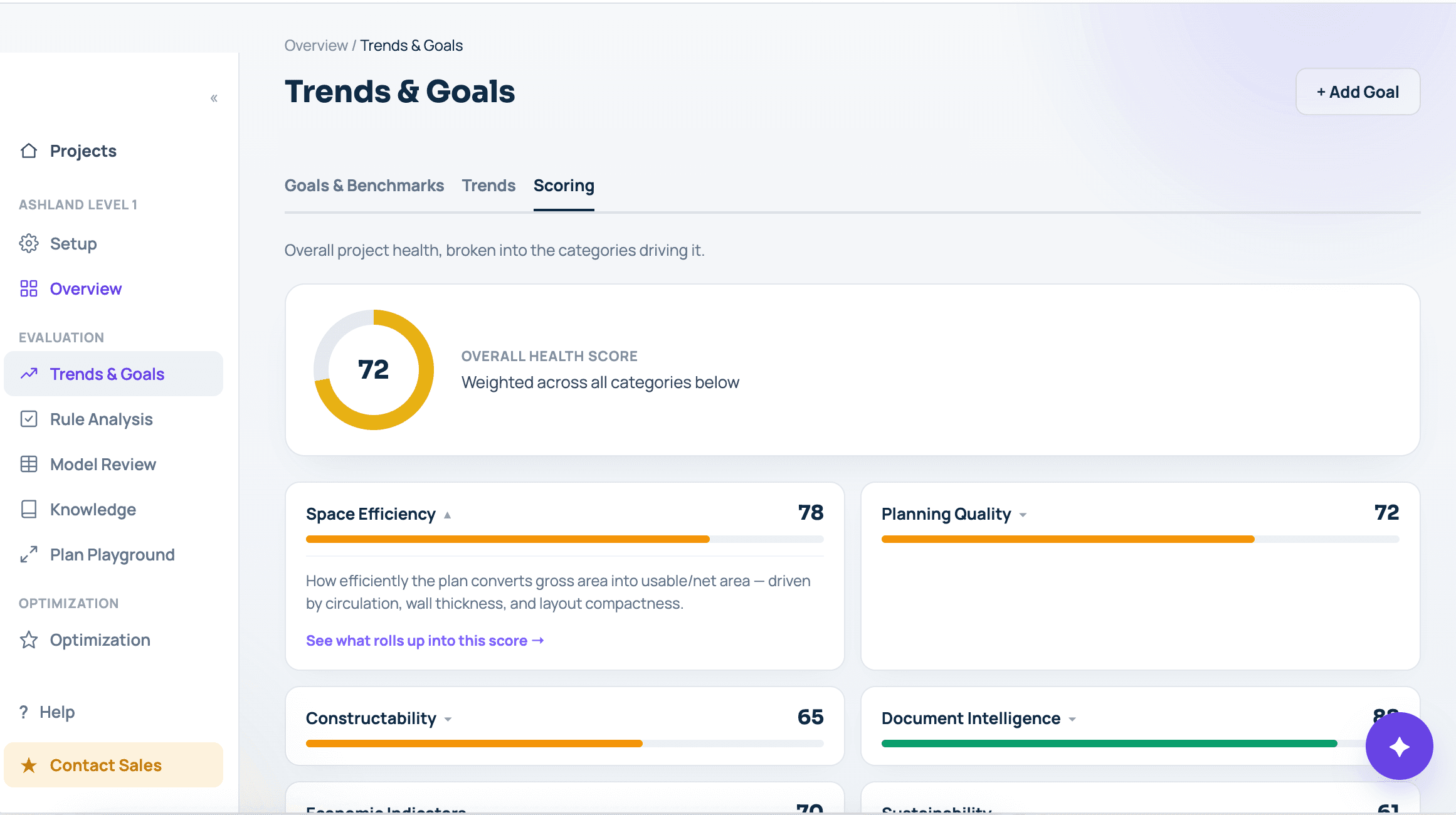
Model Evaluation & Revision History
Buildable Engine revision comparison and trends

Built for continuous improvement.

By connecting project geometry, performance metrics, requirements, and objectives, Buildable Engine provides the computational foundation for evaluating alternatives, understanding trade-offs, and moving toward better-performing projects faster — with results shared with decision-makers through Executive Reports.

What connected intelligence makes possible

The bigger gain isn't one fast analysis. It's a fast cycle.

The architecture reduces the work needed to repeat supported evaluations after a change — so teams can investigate more alternatives and decide sooner.

LEVEL 1
Accelerate one analysis
Useful — but the cycle is still slow.
LEVEL 2
Accelerate the whole decision cycle
Represent, evaluate, change, and re-evaluate without starting over.
LEVEL 3
Use faster cycles to reach a better project
More iterations, better trade-offs, faster convergence.

See how your project becomes measurable.